


Reading time: 8–10 minutes
Category: Equipment | Schiek
Keywords: weightlifting belt, lifting belt Thailand, Schiek belt, training in Thailand
You’re squatting, deadlifting, or pressing overhead — and at some point you may notice that your lower back gets fatigued faster than the muscles you’re trying to train. This isn’t weakness. It’s physiology.
Under axial load, your spine takes on significant stress, and without additional support, your progress in strength training is often limited by the weakest link — your lower back.
A lifting belt helps solve this problem. But not just any belt — the right one. This is where Schiek comes in: an American brand with over 30 years of history, trusted by professional athletes in powerlifting and bodybuilding.
How a Lifting Belt Works — Simple Physiology
Many people think a belt simply “supports the back.” In reality, the mechanism is more advanced.
When you wear a belt and brace your core before lifting, you create intra-abdominal pressure. This pressure acts like an internal support system, stabilizing your spine from all sides — front, back, and laterally.
The belt provides a surface to brace against, allowing you to generate more pressure than without it.
Result: reduced stress on the spine while maintaining — or even increasing — strength output.
That’s why experienced lifters use a belt not as a crutch, but as a performance tool.
Who Needs a Belt — and Who Doesn’t
The honest answer: not everyone, and not all the time.
When a belt makes sense:
• Squats at 70%+ of your one-rep max
• Deadlifts at 80%+
• Heavy overhead presses
• Bent-over rows with heavy weight
• Competitive powerlifting and bodybuilding
When a belt is not necessary:
• Light warm-up sets — it may create dependency
• Isolation exercises (curls, extensions, machines)
• Functional training with moderate weights — better to develop natural core stability
Key rule: a belt enhances what you already have. If your technique is poor, a belt won’t fix it.
Schiek Belt Line — Which One to Choose
Schiek offers several models designed for different needs and training levels.
Carbon Series: CF3006 and CF3004
Schiek’s flagship material — Carbon Fiber Marine Vinyl.
It provides excellent rigidity while remaining resistant to moisture. In Thailand’s humid climate, where leather belts can soften, these belts maintain their structure over time.
• CF3006 — wider back support (6 inches)
• CF3004 — slightly narrower (4.75 inches)
• Available with lever or Velcro closure
• Made in the USA
• 2-year warranty
Best for: advanced lifters, powerlifting, CrossFit, high-intensity training
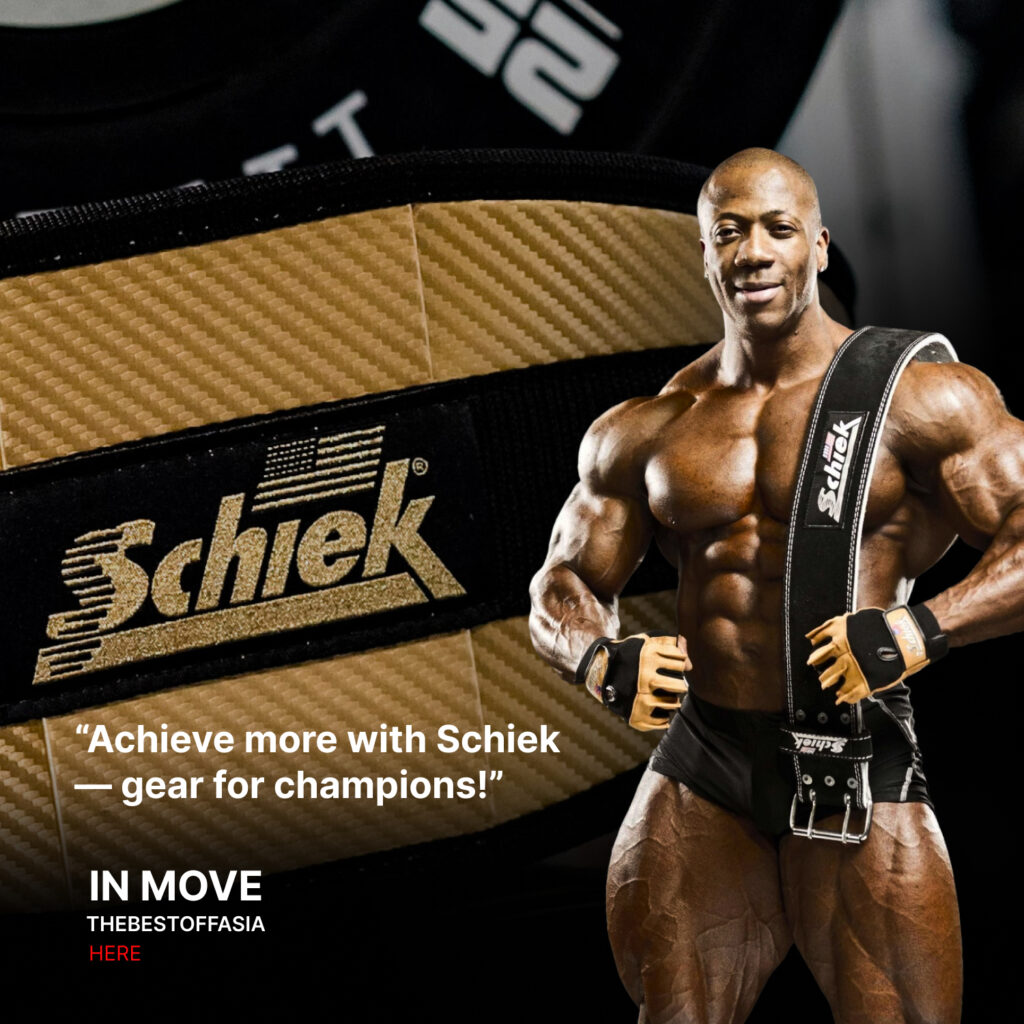
Nylon Contour Belts: 2000 & 3000 Series
Schiek’s patented contour design follows the natural shape of the lower back instead of pressing into ribs and hips.
• 3000 series — firmer nylon with metal buckle
• 2000 series — more flexible and versatile
Best for: intermediate users training regularly with moderate to heavy weights
Competition Belt L6010 (Double Prong)
• Width: 10 cm
• Thickness: 9 mm
• Material: suede
• Stainless steel double-prong buckle
Designed for maximum loads with minimal movement.
Best for: competitive lifters working with near-maximal weights
Ronnie Coleman Limited Edition
Same Carbon technology as the CF series, with signature branding.
Best for: those who value both performance and design
How to Choose the Right Size
This is a critical step.
Schiek sizing is not based on your pants size.
Measure your waist at navel level.
If you are between sizes — choose the smaller one.
A snug fit ensures proper support. A loose belt will not function effectively.
Belt Care in Thailand’s Climate
Heat and humidity can affect equipment durability.
Schiek’s materials are designed to handle these conditions, but proper care is still important:
• Let the belt air dry after training
• Avoid storing it in closed gym bags
• Wipe it occasionally with a damp cloth
• Use silicone spray on metal parts to prevent corrosion
With proper care, your belt can last for years.
Conclusion
A lifting belt is not a sign of weakness — it’s a tool that helps you train more effectively and safely.
Schiek belts combine experience, quality, and practical design that performs well in real training conditions.
If you are serious about strength training, a Schiek belt is a worthwhile investment.
All Schiek belt models are available at inmoveth.com with delivery across Thailand.